

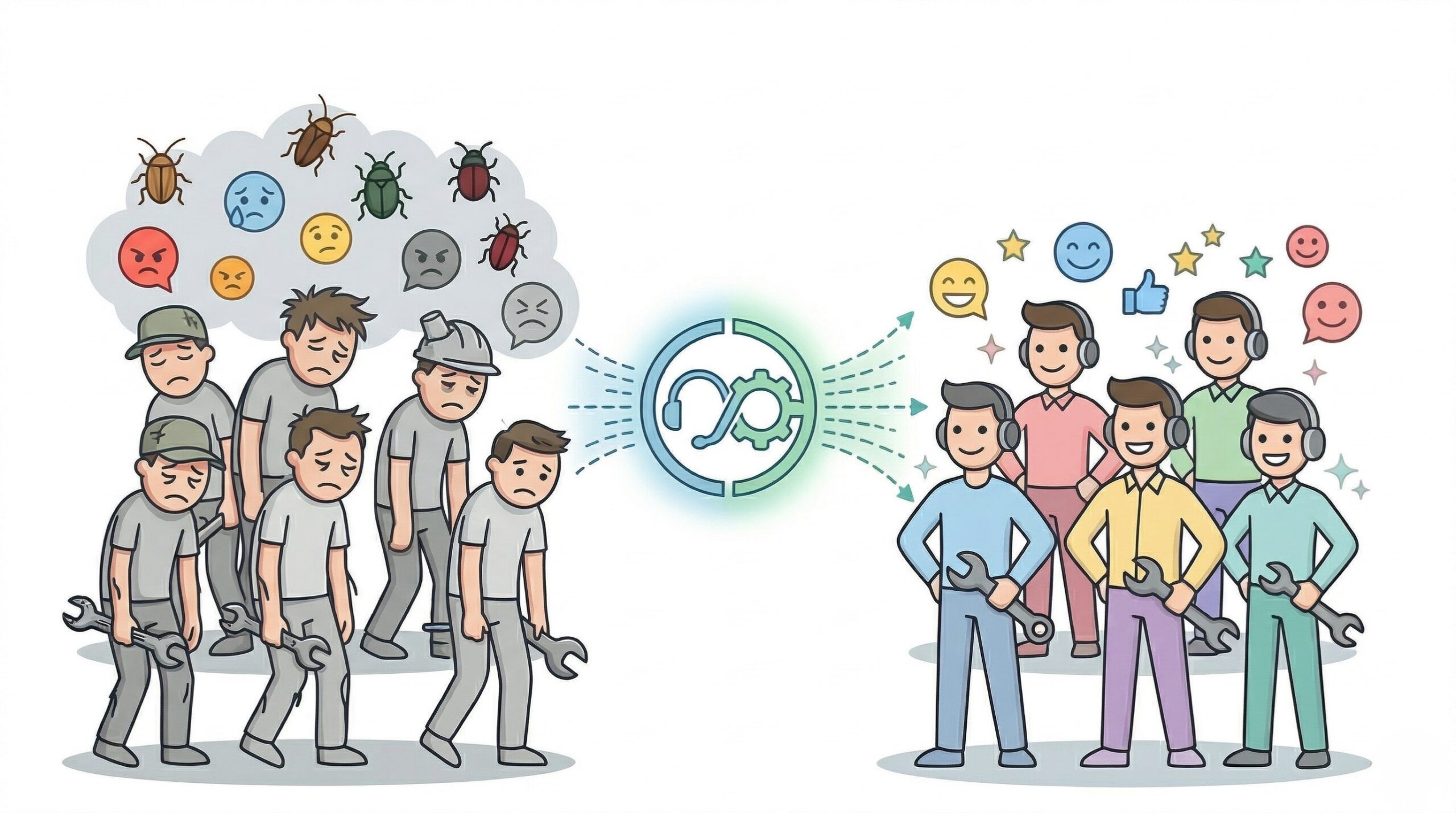
In 2026, up to 60% of customer support tickets aren’t actually support issues, they are IT failures in disguise.
If your customer support team is constantly overwhelmed, tickets are piling up, and your agents are caught in an endless loop of apologizing for the same complaints day after day, adding headcount won’t save you.
Adding more staff to a reactive support system is a temporary patch. The real breakthrough for a seamless B2B customer experience comes from linking your IT operations with your Customer Experience (CX) functions. By doing this, you shift from treating symptoms to permanently curing the disease.
The Trap of Separated Departments
In traditional business models, Customer Support and IT Infrastructure operate in separate vacuums. Support handles the angry customers, while IT manages the servers.
The danger in this separation is that they don’t share information. This keeps your business in a constant state of reaction, wasting money on an outsourced IT helpdesk or internal support team that is simply stuck managing known technical issues.
Here is what happens when you compare the traditional model to a unified approach:
| Feature | Separated Departments | Unified Ecosystem |
| Primary Focus | Reactive (fixing what is already broken) | Proactive (preventing issues before they happen) |
| Data Sharing | None (information gets trapped in silos) | Seamless (instant feedback loops) |
| Ticket Volume | High (customers report the same bugs repeatedly) | Low (root causes are fixed permanently) |
| Overall Cost | High (requires constant hiring to handle tickets) | Controlled (efficient technology replaces headcount) |
The Proactive Feedback Loop
When you unify your Customer Experience and your IT Infrastructure, you create a seamless feedback loop.
Instead of just closing tickets, a unified system uses support data as an operational intelligence tool. When Support detects a sudden cluster of five tickets reporting the exact same software bug, that data is instantly fed to the IT engineering team.
IT can then perform a root-cause fix—not just a temporary patch.
“You aren’t just answering tickets faster; you are deleting them from existence entirely.”
Suddenly, the 50 tickets that would have come in over the next hour never materialize.

3 Strategic Business Benefits
Linking your tech and your support fundamentally improves your business performance across the board.
-
Drastic Reduction in Operational Costs: By eliminating recurring “noise” tickets caused by systemic technical problems, you significantly drop your total ticket volume. You need fewer agents because your product is operating flawlessly.
-
Higher Customer Lifetime Value (LTV): Speed-to-resolution drives customer loyalty. When IT and Support are linked, complex technical problems that used to take days to fix are resolved in a fraction of the time.
-
Smarter Product Roadmaps: Your support data should guide your tech investments. A linked ecosystem transforms raw support logs into clear priorities for your IT department, ensuring you only invest in infrastructure upgrades that customers actually care about.
Redefining Outsourcing for 2026
Achieving this kind of integration internally can be incredibly difficult, often requiring months of negotiation and massive software investments.
This is why forward-thinking organizations are redefining their omnichannel support strategy. Strategic partners like Touch Support offer a unified approach. IT infrastructure, 24/7 customer experience, and elite back-office functions all work together in perfect synchronization under one roof.
You get a single team managing the entire ecosystem, eliminating the friction of multiple vendors. Stop letting disconnected departments dictate your growth ceiling. It’s time to link your infrastructure and build a strategy that scales.
Ready to Stop Reacting and Start Scaling?
Let’s calculate how many tickets a unified IT/CX setup could eliminate for your team this quarter.