

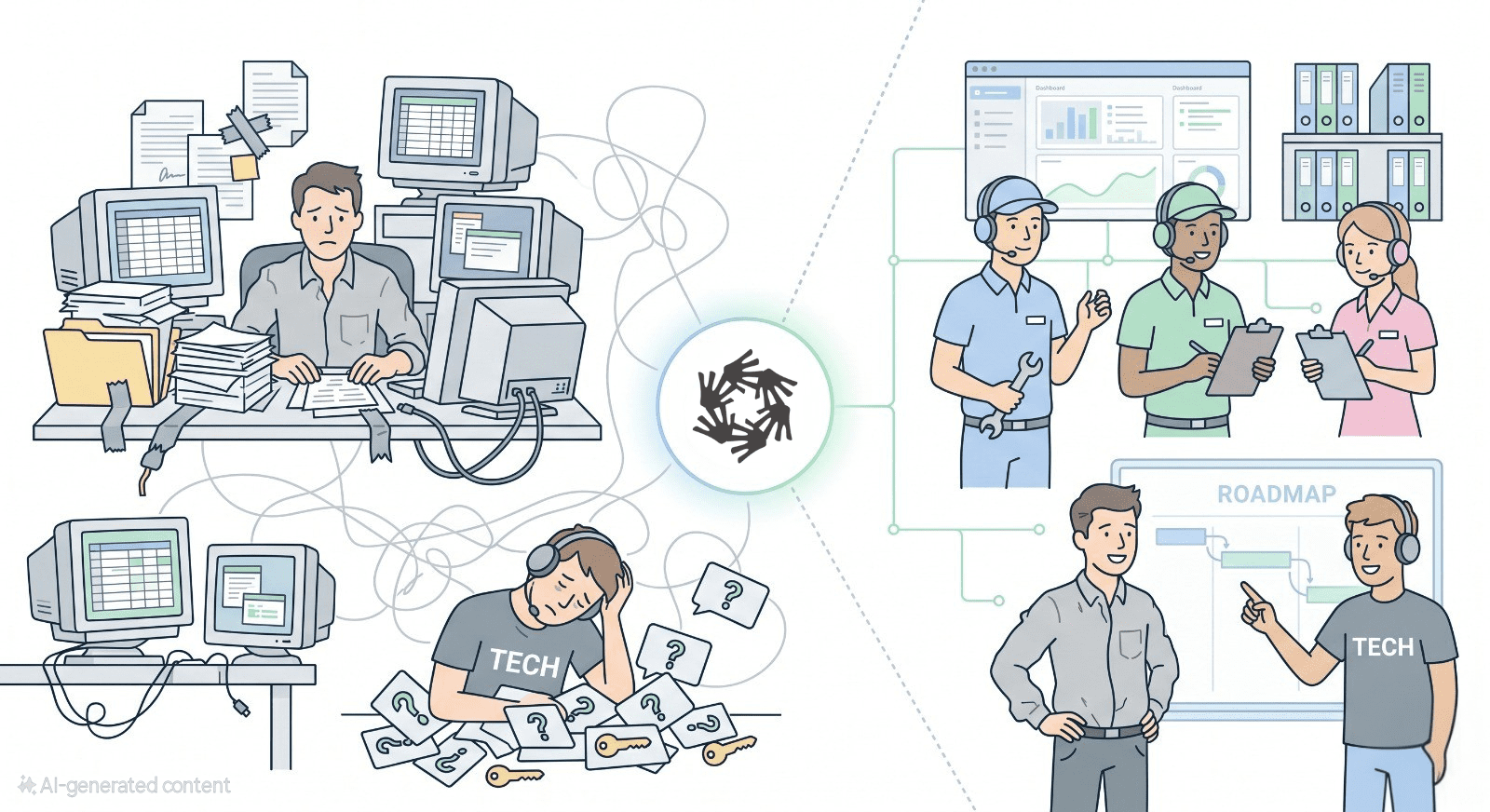
In the software world, every engineering leader understands the concept of Technical Debt. You write quick, messy code to get a feature out the door, knowing that eventually, you will have to go back and rewrite it properly before the system breaks.
But there is a much more dangerous bottleneck lurking in the background of growing companies. It doesn’t live in your codebase. It lives in your back office, your IT workflows, and your customer support channels.
It is called Operational Debt, and if you are scaling fast, it is quietly burning out your best people.
What is Operational Debt?
Operational Debt is the accumulation of messy, manual, and undocumented workflows that a company relies on to survive its early growth stages.
When you are a scrappy startup, duct tape solutions are necessary. But as your customer base multiplies, those temporary fixes become massive roadblocks.
You know you have high Operational Debt if your daily operations look like this:
-
The Hero Bottleneck: The exact protocol for a server reset or a complex customer onboarding only exists in the head of one specific manager. If they take a vacation or quit, operations freeze.
-
Engineers Playing Helpdesk: Your highly paid Tier 3 developers are spending 40% of their week resetting passwords, answering basic Tier 1 tickets, or chasing down software bugs instead of building your product roadmap.
-
Duct Taped Workflows: You are managing complex customer support issues using shared email inboxes, messy spreadsheets, or disconnected Slack threads instead of a unified, documented system.
The True Cost of the Debt
Operational Debt doesn’t bankrupt a company overnight, but it brings growth to a grinding halt.
Because your infrastructure is held together by temporary fixes, your team is constantly putting out fires instead of moving forward. You end up throwing more internal hires at the chaos, but because the underlying processes are broken, the new hires just get sucked into the same disorganized vortex.
Ultimately, your customers are the ones who pay the price. Messy back office operations lead to delayed onboarding, lost support tickets, and an incredibly frustrating, slow customer experience.
Erasing the Debt with an Embedded Partner
You cannot simply hire your way out of Operational Debt internally. By the time you recruit and train enough internal staff to clean up the mess, the debt has already compounded.
The fastest way to clear the backlog and build a scalable foundation is to drop in a professionalized, embedded operations partner.
Forward thinking companies are partnering with comprehensive BPO providers like Touch Support to instantly professionalize their IT and Customer Experience functions.
Here is how an embedded partner actually fixes the root problem:
-
Forcing Documentation: An embedded team doesn’t rely on tribal knowledge. They audit your messy workflows and build rigid, scalable Standard Operating Procedures.
-
Absorbing the Noise: They integrate directly into your existing Zendesk, Slack, or internal tools to handle the high volume grunt work. This includes Tier 1 and Tier 2 tech support, customer onboarding, and 24/7 inquiries.
-
Freeing Your Internal Talent: When the daily operational noise is handed off to an elite, integrated team, your internal managers and engineers finally get their time back to focus on high level strategy and actually scaling the business.
Stop Running on Duct Tape
Scaling your customer base without scaling your operational infrastructure is a recipe for team burnout and customer churn.
If your support and IT workflows are still running like a startup, it is time to professionalize. Stop paying your best engineers and managers to act as a high paid helpdesk. Integrate an embedded team, clean up the workflow debt, and build a foundation that can actually handle your growth.
Ready to clean up your back office?
Let’s eliminate your operational bottlenecks so your team can focus on growth.


